

Imagine a future where waste is not an end product, but a valuable resource. This is the vision driving the ‘Circulaire Ecogrondstoffenhub Schendelbeke’ project of the Flemish waste processing association, ILvA. Discover how this pioneering initiative is transforming a composting site into a hub for the circular economy through strategic sourcing.
Moving beyond traditional waste management
Traditional waste management often focuses on disposal – landfilling or incineration. While these methods are necessary for managing certain waste types and reducing immediate volume, they inherently treat waste as an endpoint. This approach fails to recognize the potential value locked within waste streams, leading to resource depletion, high energy consumption for manufacturing new materials and significant environmental impact. The circular economy offers a critical alternative by treating waste as a potential raw material.
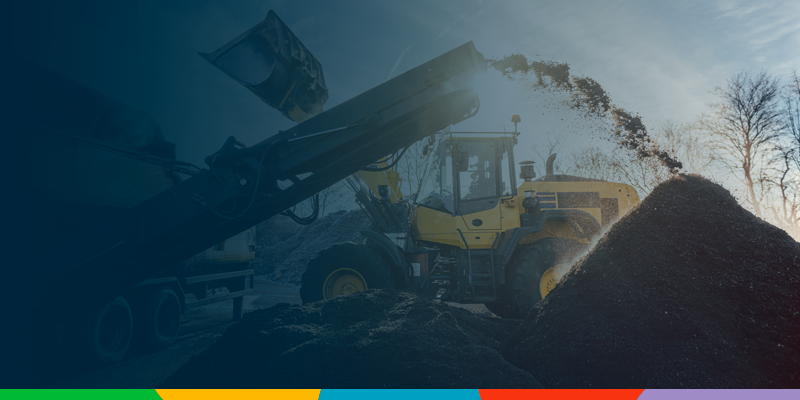
ILvA, the intermunicipal waste processing association for the ‘Land van Aalst’ region, is taking a bold step towards a circular economy with its Schendelbeke composting site. With support from VLAIO (Flanders Innovation & Entrepreneurship), they’re using strategic sourcing to transform the site into a hub for producing valuable resources from organic waste.
Strategic sourcing facilitates this transformation in 3 ways:
1. Innovation partnerships
ILvA is using an ‘innovation partnership’ procurement model. This allows them to collaborate with companies to co-develop and test innovative technologies for processing organic waste, specifically focusing on converting woody and reed-like fractions of green waste into biochar.
2. Focus on biochar
Biochar, a charcoal-like material, is produced through pyrolysis (heating in the absence of oxygen). It has numerous applications: soil improvement, carbon sequestration, water filtration and even as a renewable energy source. Because this production process requires highly specialized technology, ILvA utilized its innovation partnership model to secure the precise, cutting-edge pyrolysis equipment and expertise.
3. Pilot project
The project involves a pilot phase to test and validate the biochar production process at Schendelbeke. This pilot structure is used to manage the inherent complexity and uncertainty of new technologies. It allows for real-world optimization and ensures the chosen solution is technically effective, financially scalable, and ultimately de-risks the significant public investment before committing to full, industrial implementation.
A game-changer for climate and resource management
This project has the potential to be a game-changer for waste management and contribute to a more sustainable future:
- Reduced greenhouse gas emissions: Producing biochar from organic waste can sequester carbon in the soil, reducing greenhouse gas emissions compared to traditional composting or landfilling.
- Valuable resource creation: Biochar is a valuable soil amendment that can improve soil fertility, water retention and crop yields.
- Circular economy model: The project demonstrates a shift from a linear “take-make-dispose” model to a circular economy where waste is used as a resource.
Guiding the transition
Verhaert Strategic Innovation played a crucial role in the early stages of this project. This involved essential strategic sourcing expertise in:
- Stakeholder engagement: Organizing workshops and market consultations to gather technical and market input from potential users of biochar and technology providers.
- Technology scouting: Identifying and evaluating different pyrolysis technologies to assess their suitability and alignment with project goals.
- Strategic guidance: Providing strategic guidance to ILvA in developing the procurement strategy and facilitating the selection of the right innovation partner.
A model for circular transition
The ‘Circulaire Ecogrondstoffenhub Schendelbeke’ project is a shining example of how strategic sourcing can be used to drive the transition to a circular economy. By embracing innovation, fostering collaboration and leveraging the expertise of partners like Verhaert, ILvA is creating a model for sustainable waste management that can be replicated across Flanders and beyond.