

The “Valley of Death” is the gap between a working dual-use prototype – technology designed for both commercial and defense use – and a scalable, market-ready solution. It’s where most promising ventures quietly stall, not for lack of good technology, but for lack of an industrial plan to build it at volume. In today’s volatile geopolitical and economic landscape, that gap has become the defining challenge for dual-use innovators. A brilliant integration of AI, robotics, or advanced materials is no longer enough on its own. The firms that will lead in 2026 are the ones that treat industrialization – not invention – as the path to both sovereignty and commercial dominance. In this article, we break down why the industrialization of dual-use innovation is the key to strategic scaling, where dual-use ventures typically stall, and what a practical framework for moving from prototype to production looks like.
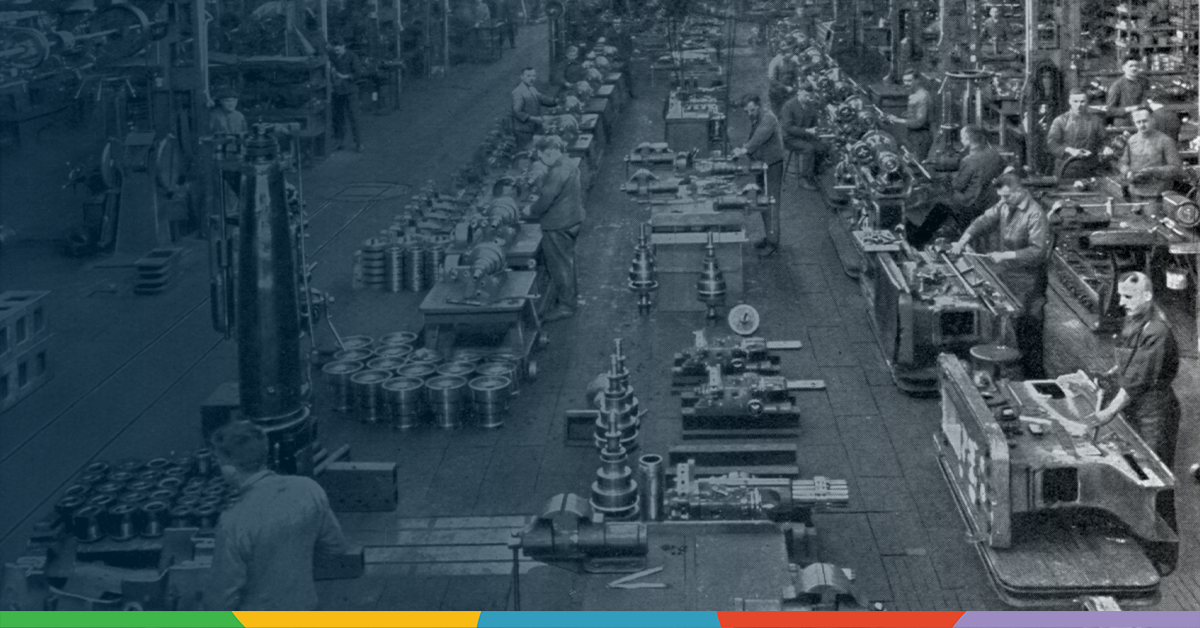
Why industrialization is the strategic move for dual-use innovation
The industrialization of dual-use innovation creates a unique ‘flywheel effect’, one chain reaction that strengthens the balance sheet and national resilience together.
Transitioning from ‘hand-built’ to automated production lines drives the marginal cost down, making defense-grade technology viable for mass-market commercial adoption. That broader commercial base is what justifies investing in a more resilient supply chain. Industrialization forces the transition from ‘fragile’ specialized components to standardized and resilient sourcing that can withstand global shocks.
A standardized supply chain, in turn, is what makes the R&D math work. Development costs for dual-use platforms are steep, but scale allows amortization to be spread across high-volume commercial sales and high-reliability government contracts at once.
And finally, industrialization is what makes ‘software-defined hardware’ more than a slogan. A standardized fleet can actually receive software updates in real time. A collection of bespoke one-offs can’t be upgraded at scale, no matter how much R&D goes into it.
Dual-use innovation often stalls at the factory gate
It’s rarely the underlying technology that fails. It’s the absence of what can be called ‘industrial DNA’, the operational instincts that let a product go from clever to manufacturable.
Three patterns repeat themselves:
- The bespoke trap: Designing products that require artisan-level assembly, making it impossible to ramp up production when a major contract lands.
- Regulatory misalignment: Failing to build ‘compliance by design’, leading to commercial products that cannot meet defense security standards, or vice versa.
- Process immaturity: A focus on the product rather than the process of making the product, leading to inconsistent quality and unpredictable lead times.
The proof: Scaling autonomous logistics
Consider the evolution of autonomous Last-Mile Delivery (LMD) drones. Initially developed for specialized commercial delivery, these systems have immense dual-use potential for medical resupply in contested environments.
By industrializing the core platform, a leading manufacturer moved from building 10 units a month to 1,000. They achieved this by using modular chassis designs. In the morning, the line produces ‘commercial’ units optimized for weight and cost. In the afternoon, the same line produces ‘hardened’ versions with encrypted comms and ruggedized sensors.
This industrial synergy ensures that the defense sector gets cutting-edge tech at commercial speeds, while the commercial sector benefits from the extreme reliability required by defense standards.
The result is a manufacturing platform that serves both commercial and defense markets without maintaining two entirely separate production ecosystems.
The industrialization framework for dual-use innovation
Industrializing a dual-use product means that leadership needs to align four dimensions of the business model at once.
| Dimension | Scaling focus |
| Manufacturing | Shift from manual ‘lab’ assembly to modular, automated production cells |
| Certification | Run ’dual-track’ QA that satisfies ISO (commercial) and MIL-SPEC (defense) at the same time |
| Data strategy | Maintain a unified digital twin across both user bases for lifecycle and performance tracking |
| Procurement | Move from project-based buying to program-based supply chain management |
None of these is a one-off project you finish and move past. They’re operating disciplines that have to mature together because a certification strategy without a matching manufacturing strategy is just paperwork.
The next step to industrial leadership
Industrialization is ultimately what transforms promising technology into deployable capability. Organizations that design for manufacturability, certification, supply chain resilience and production readiness from the outset are better positioned to scale across both commercial and defense markets.
If there’s one shift worth internalizing, it’s this: your production floor is not support infrastructure for the innovation. It is the innovation, once you’re past the prototype stage. The code, the sensors, the materials science, all of it depends on whether you can actually build the thing at scale, to spec, twice a day, every day.
Wondering whether your platform is ready to move beyond the prototype stage? We’d be glad to walk through a Production Readiness Review with you, a practical way to assess your industrial readiness and identify where your manufacturing strategy, processes and supply chain can be strengthened before a major contract puts them to the test.