

Customers of tomorrow will do more than just buy a product, they’ll search for solutions that effectively address their specific needs. What’s the secret to positioning your business for success? How do you anticipate the buying motives to design a better job-to-be-done? That’s where outcome-based innovation takes center stage!
Shifting the focus towards outcome-based innovation
In the past, the primary focus of innovation was on making products better and cheaper, integrating technologies updates and looking for new functions and better use cases. Recently though, products are getting equipped with features like performance monitoring and predictive maintenance. The start of ‘servitized products’, services on top of the product integrated into the baseline, as a competitor differentiation strategy, or as an option activated upon ordering.
Over time, this trend has been proving its efficiency in creating added value. Services that fit better with the job-to-be-done are the reason why customers assign a higher value perception compared to the remaining initial product part. Services allow shifting the functionalities and performances of the product from must-haves to rivaling and outperforming appreciation.
Creating added value through different features
So what are the typical features in outcome-based innovation that create added value? What differences are there? And does one type of feature create more added value than others? Let’s analyze some examples.
IoT home draft ~ Innovate to create new user features
How to convince beer lovers to buy an in-home beer-pouring connected appliance? With a next-level user experience. Features like real-time volume and expiration updates, personalized temperature scheduling, and a waste-reducing loyalty system create a premium experience and encourage loyalty. Especially when it’s then also linked to a points system that helps you collect free kegs. Nevertheless, these services cannot be executed through software only. It requires IoT-enabled hardware that offers the user a better deal and outcome compared to other, older products.
Clinical study IoT application ~ Innovate with convenience in mind
Regular check-ups and follow-ups at the hospital take up a lot of time for both the patient and physician. On top of that, they don’t always give accurate data but merely a sparse set of data that isn’t representative of patients’ real lives. How can you boost convenience and accuracy while taking the pressure of healthcare personnel? A mobile application that helps to conduct remote tests and questionnaires, and can be used for real-time study data, clinical tests and quality control. This is a great example of how a digital set of functions allows you to rethink the reigning use case and take it to the next level.
Stationary tilt bike innovation ~Innovate with motivational nudges
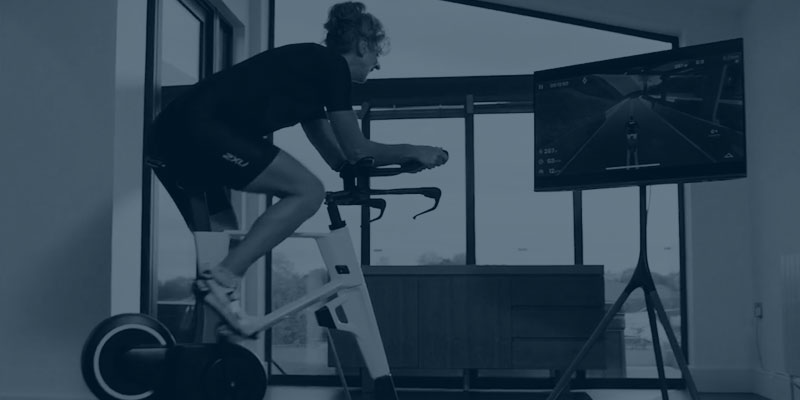
Stationary bicycles to train from home have been around for quite some time. However, doing the same training every time quickly becomes boring. How can you motivate users to stay loyal to your product? How can you pinpoint the desired customer outcomes and create more lifelike experiences? If you put the user experience first and redefine your use cases around their needs and wants, you’ll create solutions like offering endless training combinations. Effectively beating your competitors and cultivating loyal customers that never get bored.
Light-as-a-service ~ Innovate with new business models
Businesses like ETAP have already switched from selling products to selling products-as-a-service. They did a complete overhaul of their company: what they sell, how they earn money, and how products are conceived so they’re easily serviced. On top of that, it pushes them to products with lifetimes beyond traditional electronic standards, and capitalize on their portfolio. These kinds of business models require modularity not merely on the product level with serviceable and swappable parts, but also on the design level with easy-to-exchange submodules and future components.
Autonomous robots ~ Innovate to disrupt
Robotics used to stumble on the complexity of the desired outcome. Thanks to recent advances in algorithms, machine learning, and AI technologies, robots can do more than navigate and interact with their environment. They allow people to take over many repetitive, difficult, and dangerous tasks. Resulting in completely new business models, not just limited to autonomous mobility or home cleaning robots, but applications that disrupt and transform your entire business.
Stay tuned on outcome-based solutions
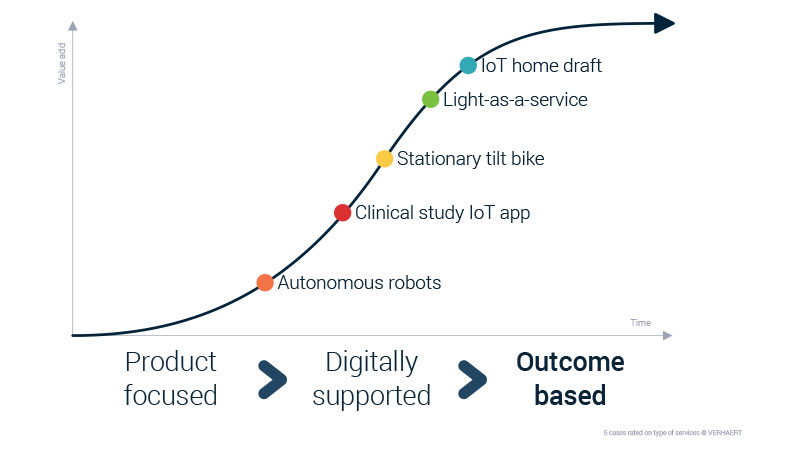
As you may have sensed yourself, these categories can be ranked somehow in increasing added value, creating new business models and even disrupting businesses. Curious to know how these five distinctive types of servitization compare? Stay tuned for our next blog to find out how they’re ranked through combined examples.
Want to experience firsthand how these solutions came about? Excited to build your own outcome-based solutions? Join our Innovation Day on November 21st!