

Axithra: Accelerating point-of-need therapeutic drug monitoring with Raman spectrometry
Verhaert’s teams turned Axithra‘s laboratory Raman technology into a portable, clinic-ready device, one prototype phase at a time.
The challenge
Axithra is a spin-off from the world-leading Photonics Research Group at Ghent University and imec. Its mission is to revolutionize therapeutic drug monitoring: a platform based on Raman spectrometry that enables healthcare professionals to accurately and rapidly measure and monitor drug concentrations directly in patients’ blood, at the point of need.
Axithra had to prove that its Raman laser and microfluidic cartridge could detect the target molecules, then turn that setup into a device a clinical laboratory could use, benchmark against the known standard, and eventually manufacture.
That path crosses many disciplines at once: optics, mechanics, microfluidics, electronics, embedded software and medical-device safety. Axithra needed a partner that could cover the full range of skills, keep scope, timing and budget in balance, and de-risk the design step by step.
To bridge the gap between initial photonics research and a scalable clinical instrument, Axithra partnered with Verhaert, leveraging the combined capabilities of its Product Innovation and High-Tech Innovation teams.
Approach & solution
We supported Axithra across three consecutive phases, each with a clear purpose and a clear question to answer. The High-Tech Innovation unit brought its specialized expertise in optical design and optical instrumentation, complemented by the multidisciplinary product development capabilities of the Product Innovation team. The teams combined their expertise in system engineering, mechanical and optomechanical design, electronics, embedded systems and medical-device development (ISO 13485-certified) to turn the laboratory setup into a safe, buildable product. One project management line linked Axithra’s team with both business units.
Phase 1: Breadboard – Proof of concept
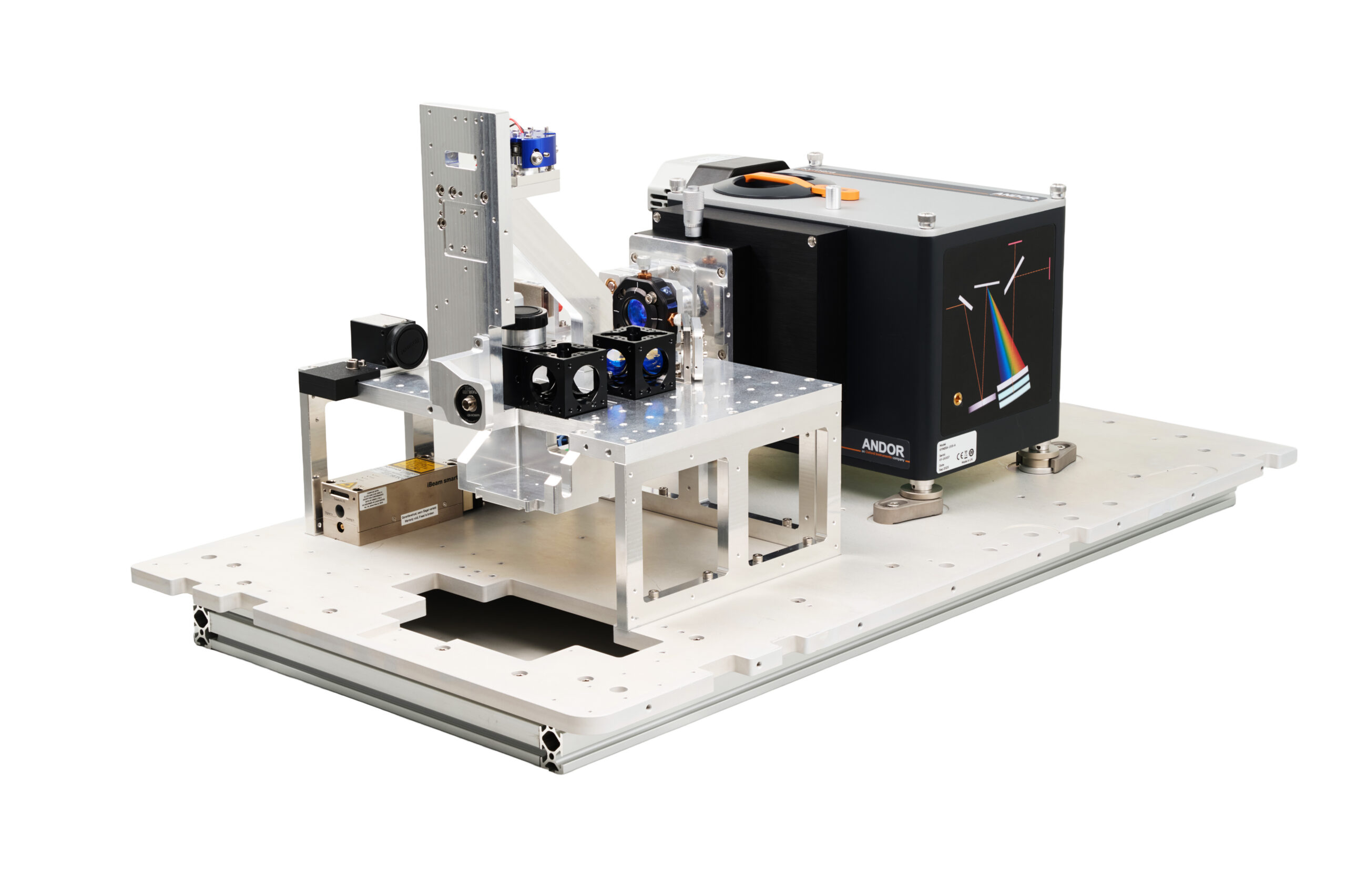
- Goal: Validate the core detection of defined target molecules using Raman laser technology and microfluidic cartridges on an open-frame optical bench setup.
- Execution: The High-Tech Innovation team provided specialized optical design, optical bench testing and dedicated on-site technical support.
- Outcome: Successfully achieved proof of concept for the optical sensing mechanism. The Raman and microfluidic approach worked on the optical bench.
Phase 2: Pre-alpha prototype – Proof of technology
Goal: Transform the open-frame setup into a portable device that can validate blood-sample tests in a clinical laboratory and benchmark them against the known standard. The device had to validate three assays for three different molecules, de-risk cartridge insertion and positioning, and validate the cartridge design.
Both Verhaert’s teams contributed:
- System architecture and system safety assessment and implementation
- Optical design, optomechanics and mechanical integration
- Co-design of the microfluidic cartridge
- A manual cartridge loading mechanism
- Electronics and cabling
- Building and functionally testing two complete pre-alpha devices, along with one clamping test device for use in the open-frame setup
Outcome: Two devices delivered on time, with first-time-right performance. The devices gave Axithra’s board of directors the ‘proof of technology’ it needed to move forward.
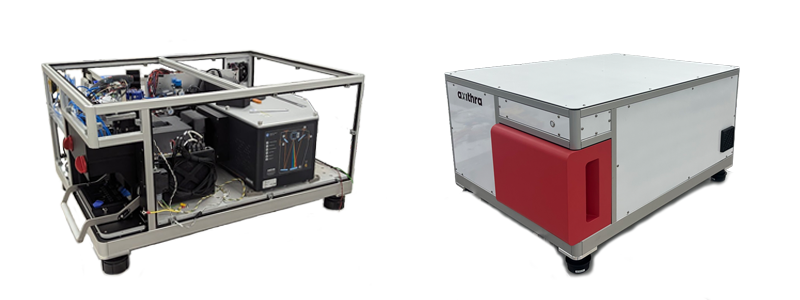
Pre-alpha prototype
Phase 3: Alpha prototype – Design for low-volume manufacturing
Goal: Design for low-volume manufacturing, concept cost-down solutions and reduced footprint.
This phase moves from ‘does it work?’ to ‘can it be built, repeatedly and affordably?’:
- Spectrometer selection and optical alignment
- Co-design of the microfluidic cartridge and cassette
- A diskette-like manual cartridge loading mechanism with an automatic clamping system
- Mechanical cartridge actuation (valves and blisters) and pneumatic cartridge actuation
- Embedded hardware and software
- An integrated frame and housing design
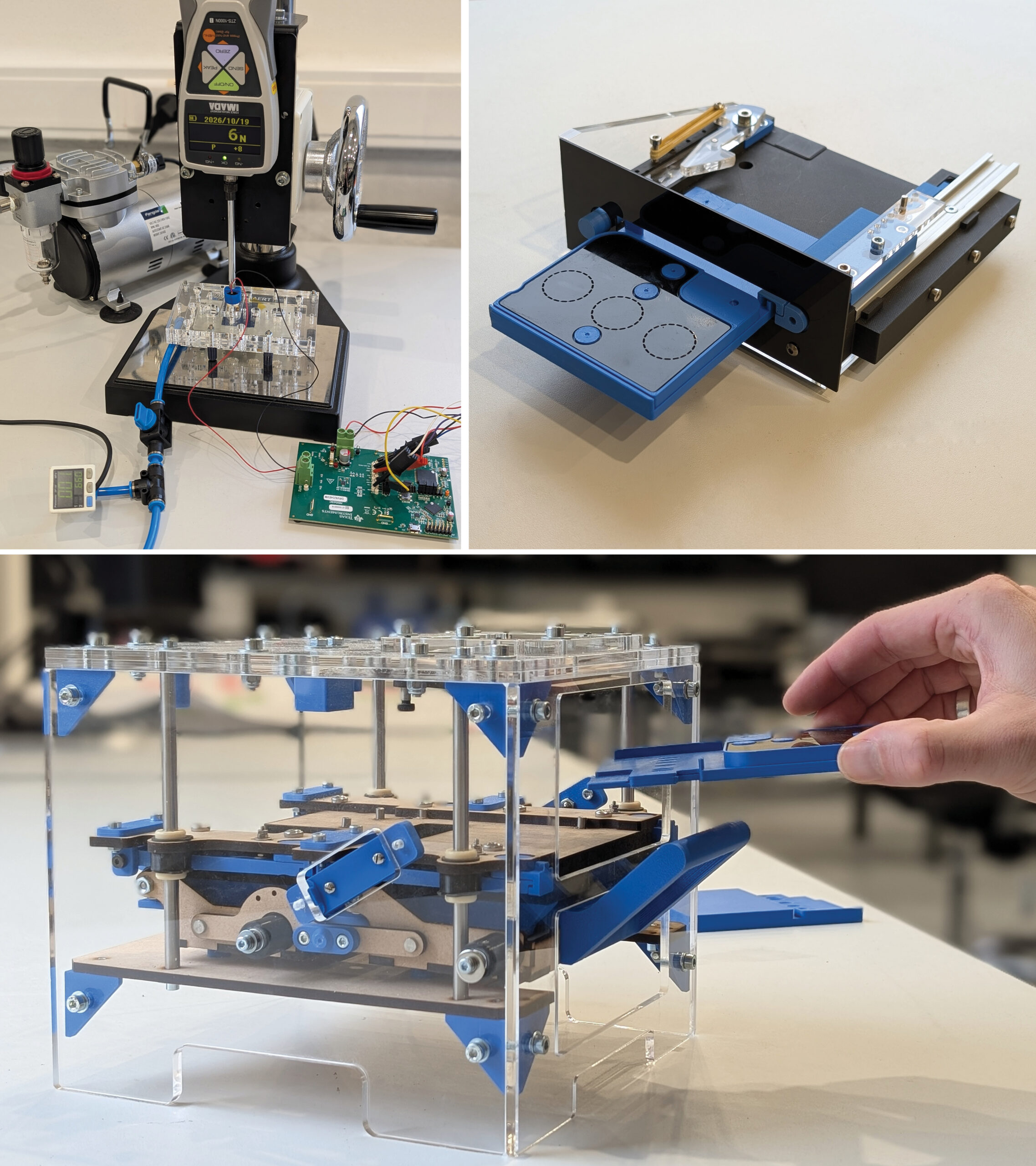
To de-risk the crucial functions and interfaces,
we built sub-system breadboards and mock-ups for early testing.
Each phase closed with a concrete milestone that moved Axithra closer to a market-ready instrument. The alpha phase is not finished yet, but its direction is clear: low cost, design for manufacturing & assembly, fully functional and ready for CE certification as an IVD.
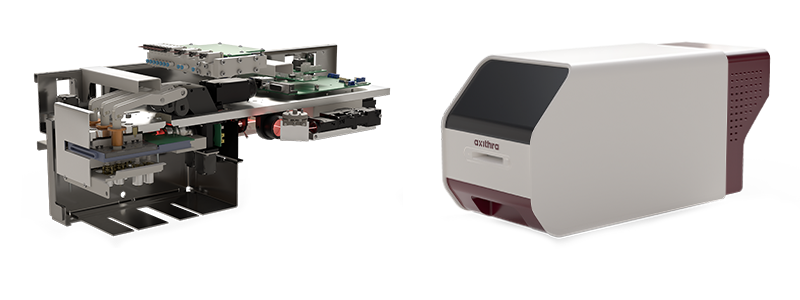
Images of the first functional demonstrator which will be ready
by the beginning of November 2026.
Impact & Results
Through the joint capabilities of Verhaert’s Product Innovation and High-Tech Innovation teams, Axithra rapidly progressed from a laboratory concept to a clinical-grade demonstrator:
- On-time milestones & investor confidence: Reached crucial ‘proof of technology’ goals on schedule, providing investors with tangible proof of performance.
- De-risked technology & scalability: Successfully de-risked complex optomechanical, microfluidic, and electronic interfaces, paving the path toward alpha pilot manufacturing (10 units) and certification.
- Accelerated time-to-market: Combining high-level systems engineering with specialized optical instrument manufacturing allowed Axithra to navigate startup investment cycles without needing to build an internal multidisciplinary engineering infrastructure.
Any questions?
Developing a complex optical or medical device and need one team that covers optics, mechanics, electronics and software? Get in touch to talk about your project!