

For decades, sharper images meant heavier optics, higher costs and painful engineering trade-offs. But AI is starting to flip that logic on its head. From “enhancing” grainy footage in crime shows to real-world deblurring in satellites, microscopes and cameras, the line between science fiction and engineering reality is getting… surprisingly blurry. Let’s unpack what’s actually possible today.

Base imagery © 2023 Hexagon and data partners
A rising demand for high-quality imaging
In today’s imaging industry, the demand for ever-higher image quality is relentless, yet constraints on cost, weight and size continue to challenge engineers. Meeting these requirements often means more complex or larger hardware, pricier components, and increasingly demanding testing, all of which push projects toward higher budgets and longer development cycles.
Meanwhile, AI-driven image enhancement tools are rapidly advancing and becoming more widespread, from image deblurring features in Lightroom and Photoshop to AI upscalers and generative models like Stable Diffusion. This raises a compelling question: Can artificial intelligence remove blur and improve usable image resolution without altering the existing optical hardware? In other words, could we now finally achieve the kind of dramatic ‘image enhancement’ often depicted in popular TV shows in real-world applications?
Rewriting image quality with AI
The answer? Kind of. The big breakthrough is that artificial intelligence can now act as a kind of ‘virtual upgrade’ for optical systems. By training models on images from high-end cameras or sensors, developers can teach AI to reconstruct what a better system would have seen. In practice, this means cheaper, smaller and lighter optics can produce images that look like they came from far more expensive hardware, dramatically reducing overall system costs.
There are two especially promising approaches. The first is to use AI to boost the image quality of cheaper cameras and sensors, allowing low-cost, lightweight hardware to produce results closer to premium systems. This can also be used in constellations of sensors or satellites: a few units carry premium optics, while many others use simpler hardware. The second is retrospective enhancement: applying AI for image deblurring in hardware already deployed in the field, improving quality without any physical upgrades. Together, these approaches show how AI can extend the capabilities of both future and existing optical systems, purely through software.
At its core, this technique is generative: the AI starts with a degraded image and generates a sharper, higher-quality version. This only works well if the distortions and noise of the real optical system are accurately modeled during training, which requires deep technical expertise. A strong starting model is also crucial, using an AI already trained to deblur regular images makes adaptation faster, cheaper and more reliable. This is how you can reuse and fine-tune existing models to turn image enhancement from a research challenge into a practical engineering tool.
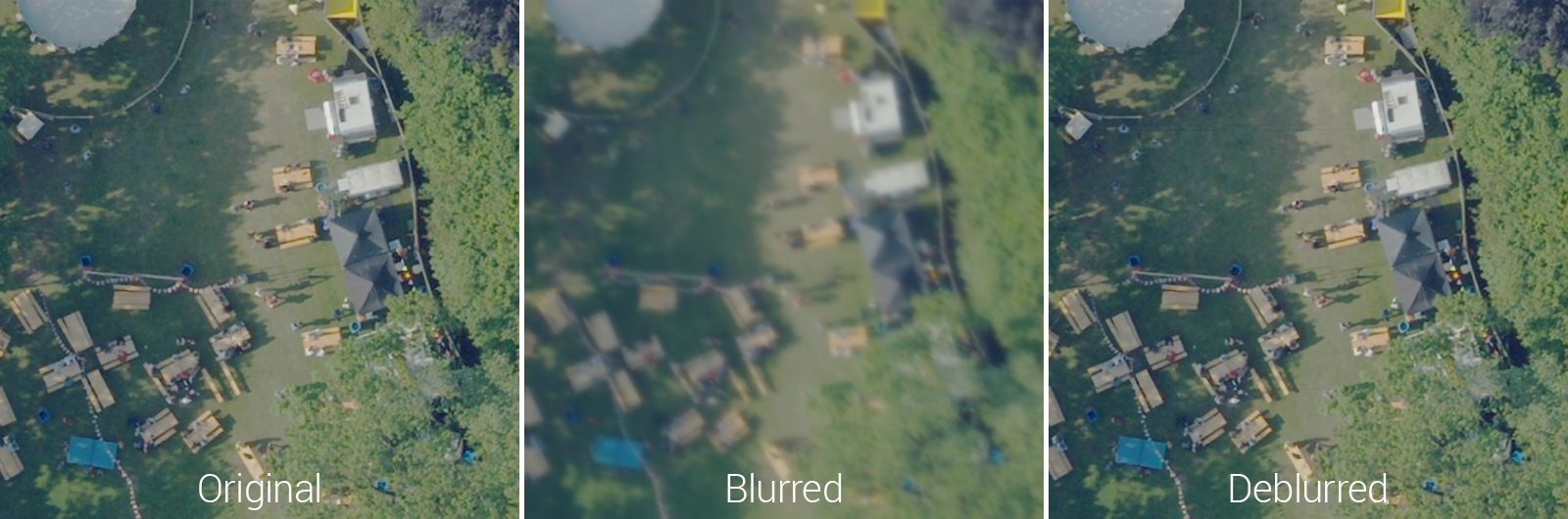
Base imagery © 2023 Hexagon and data partners
AI in action: From space to surgery
AI-powered image enhancement is starting to improve real-world systems across the board. Any product that relies on optics can benefit: from drones monitoring traffic and satellites mapping crops and deforestation changes, to smartphones capturing sharper photos without bigger cameras. Even weather alerts and environmental policy enforcement can be more accurate thanks to clearer, AI-enhanced imagery.
In optical systems for life sciences, AI image deblurring can boost standard microscopes by leveraging training on high-resolution systems. This approach offers high-resolution capabilities to millions of conventional microscopes in the field, improving live-cell imaging, digital pathology and microbial detection. It also supports low-cost diagnostic devices and high-throughput drug screening. This will help researchers and clinicians gain clearer, more reliable insights without upgrading hardware, making advanced imaging more accessible, scalable and cost-effective.
Generative constraints and reliability
AI-based image deblurring is powerful, but it isn’t magic. It can’t recover information that was completely lost in the original image. Since it’s a generative process, it can also introduce artifacts. This is inevitable, but in most cases, not a dealbreaker. For example, imagine a blurred photo of a pedestrian holding a small object. After deblurring, the pedestrian becomes clearer, but the artificial intelligence can only make an educated guess about the object. They might reconstruct it as a phone, a coffee cup, or something else entirely, but for tasks like counting pedestrians or detecting presence, this isn’t a problem.
The AI works much like humans do: it interprets shapes and context to reconstruct likely features, but the accuracy depends heavily on the quality and variety of training data. That’s why high-quality images across diverse conditions and blur types are crucial. By understanding these limits, AI deblurring can be used responsibly, enhancing images without creating misleading or false information.
A new era of optics and AI
AI-driven image enhancement is already proving to change the game tremendously. It can boost the performance of cheaper cameras and sensors, and even improve images from hardware that’s already out in the field. Better-quality imagery at lower cost could transform Earth observation, from tracking traffic and deforestation to responding faster to disasters. While the impact will be huge, broad adoption will likely happen step by step. As artificial intelligence continues to get smarter, the line between what optics alone can achieve and what software can deliver will keep blurring, opening new possibilities for how we capture and use images across industries.