


The misconception: Europe is losing the tech race
There’s a prevailing narrative in defense circles that Europe is falling behind because it lacks cutting-edge technology. We look at the rapid rise of commercial AI, autonomous systems, and advanced sensors elsewhere and assume European defense suffers from an innovation shortage.
But this is a myth. Europe doesn’t have an innovation problem. European labs, start-ups, and commercial tech hubs are overflowing with world-class capabilities. The main bottleneck is that Europe suffers from a shortage of mechanisms that turn commercial innovation into operational capability.
Why the gap exists: The procurement wall
Historically, defense innovation flowed from military R&D down to the civilian sector (think GPS or the internet). Today, that current has reversed. Over 80% of critical emerging technologies are driven by commercial R&D, not defense spending.
Over 80% of critical emerging technologies today are driven by commercial R&D, not defense spending.
While commercial tech cycles are measured in weeks, traditional military procurement cycles are still measured in years, sometimes longer. This creates a structural misalignment:
- The valley of death: Start-ups develop groundbreaking dual-use solutions but go bankrupt trying to deal with rigid, bureaucratic defense acquisition processes.
- The requirements mismatch: Commercial tech often fails to meet strict military ruggedization, cybersecurity or interoperability standards.
- The scalability trap: A successful technology demonstration or pilot project rarely translates into a deployed, mass-produced operational and qualified asset.
So the bottleneck isn’t technology creation, it’s the adoption pipeline.
Introducing ‘innovation absorption’
To bridge this gap, European defense forces and defense contractors (and leaders) must shift their focus from inventing new technologies to mastering innovation absorption. This is an organization’s ability to identify external, commercially available technologies, validate their operational relevance, ruggedize them for harsh environments, and scale them rapidly into active service.
This is where dual-use innovation becomes a strategic necessity rather than a buzzword. Dual-use technologies, such as industrial drones adapted for tactical reconnaissance, or secure commercial IoT architectures strengthening battlefield communications, are already funded, tested and scaled by the market.
Adapting commercial off-the-shelf (COTS) technology can reduce deployment timelines by up to 60%.
By focusing on absorption rather than creation, Europe can leverage these dual-use ecosystems to bypass long R&D phases entirely. Adapting commercial off-the-shelf (COTS) technology can reduce deployment timelines by up to 60%, but this requires a deliberate, structured methodology to bridge the civilian and military worlds.
Building the absorption pipeline
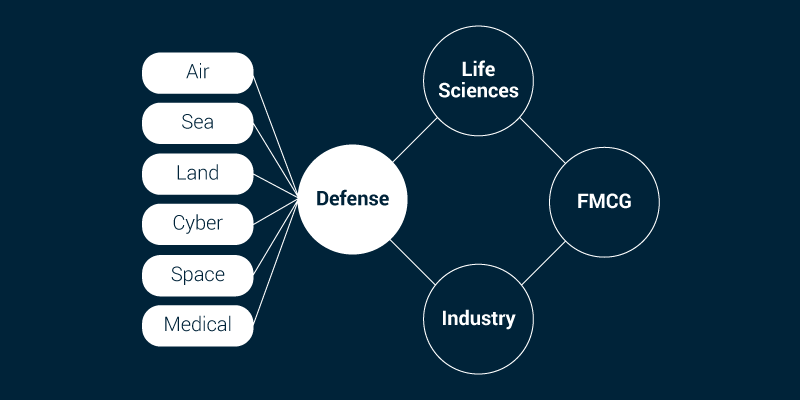
For over three decades, Verhaert has operated at the intersection of advanced tech, industrial innovation, and strategic defense capability. This experience has provided insight into the mechanisms crucial to assessing, adapting and integrating commercial technologies into defense contexts.
- Strategic sourcing & scouting: Starting from the capability gaps, we identify and validate emerging tech from across Europe and, broadening your access beyond traditional procurement channels.
- Validation & operational testing: Not every promising tech is deployment-ready. That’s why we organize rigorous testing environments and demonstration programs to assess real-world mission relevance and, minimizing risk.
- Capability building: Technology alone doesn’t win. Through consulting and training, we help your organization build innovation as a core, repeatable capability.
- Engineering & system integration: Commercial products must be ruggedized, secured and adapted for harsh environments. Multidisciplinary engineering teams handle system architectures, AI integration, cybersecurity, optics, electronics and much more.
- Industrial scaling & production: We bridge the gap from prototype to deployment by supporting pilot production and scalable manufacturing, ensuring innovations become true operational assets.