

Cell-based therapies, especially Chimeric Antigen Receptor (CAR) T-cell therapies, have evolved from scientific advances to established pillars of oncology. By re-engineering immune cells to target specific cancer markers, these “living drugs” offer curative potential where traditional treatments fail. However, in 2026, the strategic challenge has shifted: the industry must now move from “bespoke” clinical success to high-volume, predictable manufacturing.

The state of things: The $475,000 ceiling
In 2026, extreme reimbursement pressure defines the economic landscape. Established therapies like Novartis’s Kymriah list at about $475,000 (USA price), but total care costs, including ICU monitoring and complex logistics, often exceed $1.2 million.
Outcome-based reimbursement now ties payments to long-term patient survival. For developers, a failed batch or process delay is not just a lost product but a direct financial and regulatory liability. Reducing Cost of Goods Sold (COGS) via smarter equipment architecture is essential for commercial sustainability.
The challenges: overcoming the scaling barrier
Despite commercial success by leaders like Kite Pharma and Legend Biotech, manufacturing costs remain high. These challenges fall into three main categories:
1. The human variable (labor & expertise)
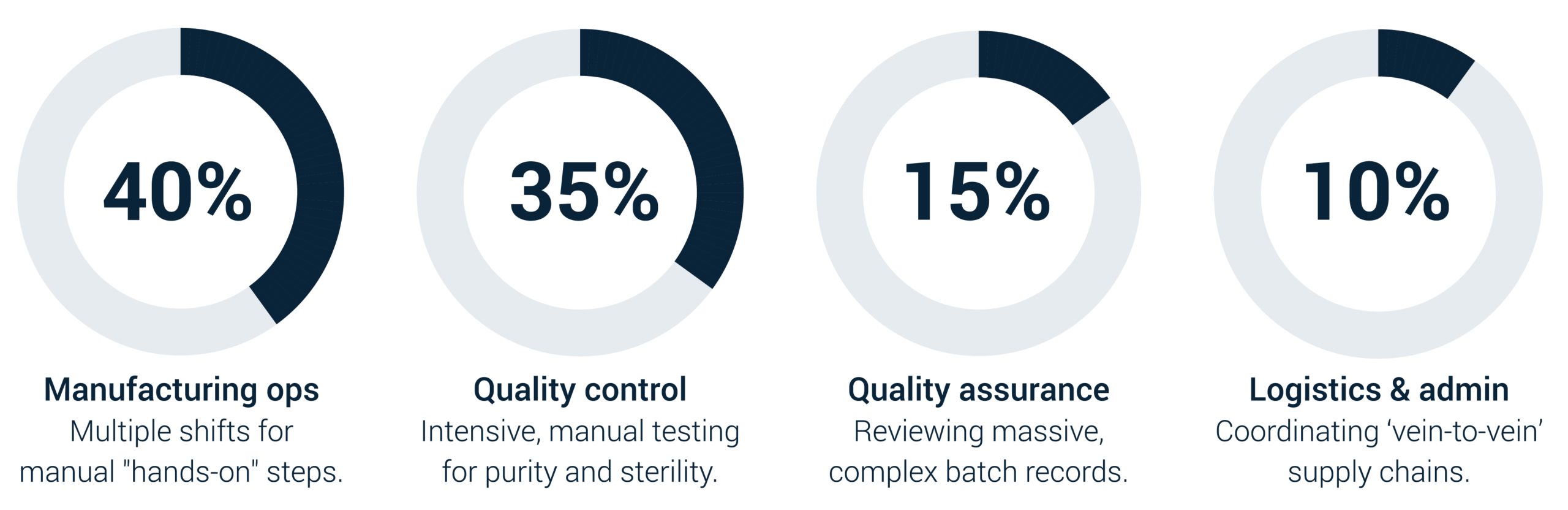
Manufacturing remains heavily dependent on manual intervention. Our analysis¹ of 2026 industry benchmarks shows that labor accounts for 45-50% of total COGS.
2. The facility footprint
Manual processes require “open” systems and Grade B cleanrooms, which are significantly more expensive to build and operate than lower-grade environments due to strict HVAC, gowning, and monitoring requirements.
3. The ‘comparability trap’
Many innovators rely on manual, ‘open’ processes during phase 1, ‘Proof-of-Concept’, to reach the clinic quickly. However, by the time they reach phase 2b or 3 clinical trials, the transition to automated platforms often alters the cellular product’s phenotype or potency. This triggers a mandatory comparability study, a major regulatory hurdle that can lead to years of delay or even a Complete Response Letter (CRL) from the FDA. Success in 2026 requires an ‘automation-by-design’ strategy that integrates scalable equipment architecture before the first patient is even dosed.
Insights for COGS reduction: A technological roadmap
The path to reducing COGS lies in how equipment is designed to handle the biological journey. We see three main areas where technical intervention yields the highest ROI:
1. Transitioning to functionally closed systems
The primary goal is to encapsulate the process – from activation to harvest – within a sterile, operator-independent environment.
Moving to functionally closed systems enables manufacturers to operate in less costly Grade C or D cleanrooms instead of expensive Grade B environments, reducing facility overhead by an estimated 20-30%.
Achieving this shift requires more than a closed loop. It demands precision-engineered single-use fluidic manifolds optimized for laminar flow and low shear stress. We emphasize integrating non-invasive sensor arrays using optical and ultrasonic technologies directly into the flow path. By sensing through manifold walls or using gamma-sterilized inline components, sterility is maintained while providing a digital orchestration layer. This not only monitors the process but creates a self-documenting, high-integrity environment that replaces manual QC with hardware-level validation.
2. Future-proofing scale: From modularity to multi-batch
While scaling out (parallel modularity) is the current industry standard, the roadmap toward 2030 points to process intensification.
Not every enterprise is ready to adopt multi-batch platforms today. The immediate opportunity is to design modular systems that improve efficiency through shared subsystems.
For those ready to scale further, analyzing concurrent multi-batch platforms – where one system processes multiple patient batches in isolated parallel lanes – can maximize throughput per square meter of cleanroom and significantly reduce depreciation costs per patient.
3. The ‘comparability trap’
In 2026, relying on end-of-process testing is a high-risk strategy.
Incorporating real-time metabolic sensors (glucose, lactate, pH) directly into equipment provides immediate process visibility. In practice, teams increasingly combine optical and electrochemical sensing (e.g., spectroscopy/imaging plus pH/DO/glucose/lactate) to reduce manual sampling and detect drift earlier. The other half of the equation is software built for auditability: data integrity, traceability, and cybersecurity by design, so process intelligence can credibly support release decisions and tech transfer, not just R&D experiments.
Using digital twins to simulate thermal and fluidic behavior enables automated ‘corrective adjustments’. When implemented effectively, this reduces late-stage surprises and recovers time lost to manual QC and deviation handling.
The state of things: The $475,000 ceiling
In 2026, science is often proven; commercial sustainability depends on industrial execution. Accelerating growth through the industrial development of medical equipment constitutes a critical strategic differentiator. The most durable COGS gains come from reducing operator-dependent variability, designing for functional closure, and shortening feedback loops between process signals and decisions.
Two questions help teams focus quickly: (1) Is your main constraint QC lead time, facility utilization, or batch failure risk? (2) Which unit operation still relies on ‘expert operators’ rather than defined control limits? Clear answers usually identify the next best investment in automation, analytics, or GMP-ready architecture.
The science is proven. Is your industrial execution ready?
If you are struggling to move from a manual ‘hands-on’ process to a predictable, high-volume system, you need a partner who understands the full innovation journey. Our team specializes in co-creating life sciences products that are built for the market from day one. We help you integrate connected IoT devices, user-centric hardware, and scalable architectures to ensure your ‘living drug’ is as commercially viable as it is scientifically ground-breaking.
Ready to turn your scientific breakthrough into a sustainable commercial success? Get in touch with our Product Innovation team to boost your R&D capacity and co-create the systems you need to win in the market.
Download the one-page guide to solving cell therapy bottlenecks
(1) These figures are a synthesis of data from:
Lab Practices Committee – International Society for Cell & Gene Therapy. (n.d.). Higher Logic, LLC. https://www.isctglobal.org/about/isct-committees/lpc
Mordor Intelligence. (n.d.). Manufacturing services research reports and market analysis. https://www.mordorintelligence.com/market-analysis/manufacturing-services
PricewaterhouseCoopers. (n.d.). Cell and gene therapy: how to overcome manufacturing challenges. PwC. https://www.pwc.be/en/news-publications/2023/how-to-overcome-manufacturing-challenges.html